

Retained joinery · Non-structural finishes
Water Damage Restoration in Hackney
We assess water-affected Hackney interiors, review retained non-structural timber and finishes and plan drying before the agreed interior reinstatement.
- Retained joinery assessed in its installed setting
- Physical timber changes distinguished from moisture
- Preparation and replacement boundaries defined
Affected areas assessed
Drying arrangement defined
Changes explained before work
Interior scope agreed
We assess retained interior joinery alongside the room
We plan restoration in Hackney homes where wetting has affected non-structural timber trim, cupboard surrounds or other retained interior joinery. The proposal identifies the component and its setting, rather than treating every timber mark as a floor problem. We connect the material assessment with appropriate drying and the preparation or renewal expressly accepted for the room.
We describe the affected item in ordinary component terms so the proposal does not confuse a decorative surround with a structural member or a complete furniture installation. The client can identify what remains and where preparation or renewal is proposed. We also show how that item meets the adjoining wall finish. This keeps the accepted response tied to the observed condition rather than a general promise to restore all timber in the room.
We establish safe assessment before testing movement
We collect the source history and accessible description without asking an occupant to force a swollen component or disturb wet fittings. The source and affected utility responsibilities are confirmed separately. Unsafe construction or suspected contamination requires the appropriate provider before ordinary drying or timber finishing. We arrange the assessment around the permitted accessible area.
We connect retained joinery condition with the room finish
Identify the affected interior item
We collect incident information and establish the permitted safe area and the particular non-structural joinery involved.
Inspect fit and surface changes
We review accessible component condition, decorative junctions and access limits before defining further intervention.
Agree appropriate drying
We identify equipment and operating responsibilities around the retained material without a promise that deformation will reverse.
Decide the material response
We review the actual item and chosen finish requirements before accepting preparation, renewal or replacement.
Complete the appointed junctions
We carry out the agreed interior stages and review the retained and new surfaces against the accepted item list.

We inspect the installed component and adjacent finishes
We review visible swelling, opened decorative junctions and changes in the surrounding coating. We identify what can be assessed without dismantling and where further access needs agreement. A changed joint line can inform the assessment, but it is not used alone to decide the condition of concealed fixings or to commission structural timber work.
The accessible review looks at the installed relationship as well as the visible face. We identify any changed contact, local swelling or surrounding coating line without forcing the item into a preferred position. Where a concealed attachment or background cannot be examined, we record that limit. Further disturbance is proposed only for an identified need, with the actual intervention agreed before a retained assembly is altered.
We keep the physical shape separate from moisture information
We consider the accessible material findings and the actual fit or movement observed at the joinery. An improved indication is not a dimensional survey of the whole assembly. Where the accepted drying review identifies a continuing physical concern, we explain the next material decision instead of describing the item as recovered solely because equipment operation has progressed.
We distinguish the evidence that informs drying from the evidence about the component’s fit. A material indication does not measure every clearance, and a visible improvement does not establish the condition of a hidden back. We consider those observations together when discussing retention or renewal. If an item remains physically unsuitable for the accepted finish, we identify that unresolved decision instead of treating equipment progress as proof of recovery.
We plan drying around retained timber surfaces
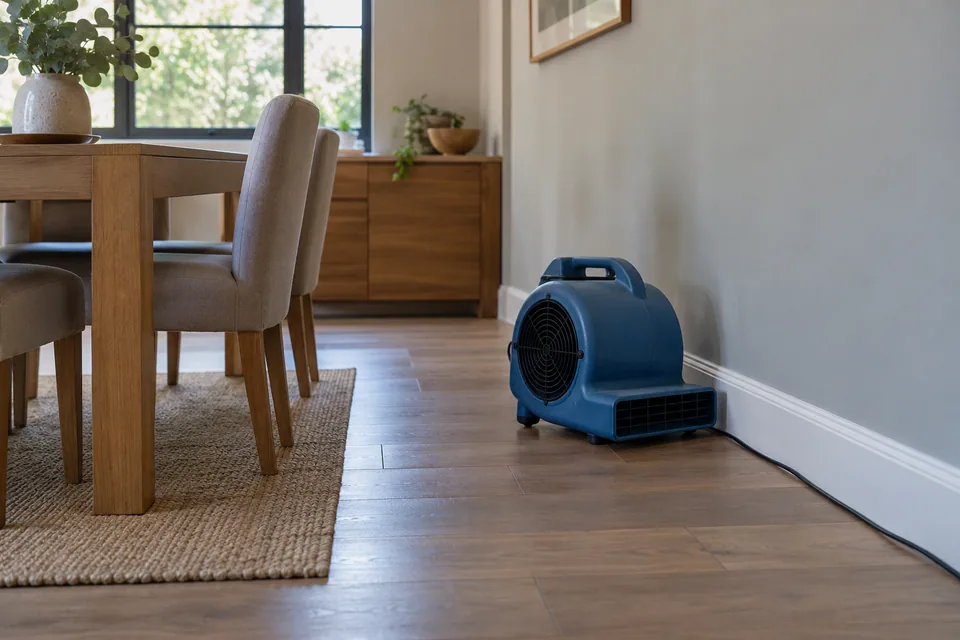
We define suitable dehumidification and circulation for the agreed material task. High heat is not treated as an automatic way to restore timber shape; the retained construction and surrounding finishes need consideration. Equipment clearance and operating responsibility are agreed without assuming that a covered back face receives the same exposure as the visible front.
The drying proposal considers the retained timber, nearby decoration and the faces that are actually accessible. We identify circulation and appropriate dehumidification without using intense heating as a substitute for review. The operating contact and any adjustment responsibilities are agreed for the task. Where another technical assessment is needed, we identify it before proceeding rather than promise that ordinary drying will make every component fit as it did before wetting.

Drying around retained timber
| Provision | Purpose | Boundary |
|---|---|---|
| Dehumidifier | Remove air moisture | Not dimensional correction |
| Air mover | Accessible circulation | Placement assessed |
| Material indication | Inform drying review | Not whole-item fit test |
| Component review | Physical condition | No structural clearance |
We distinguish decorative joints from component condition
We assess the actual timber item and its coating before proposing preparation, suitable renewal or replacement. A paint line that has opened is not automatically the same defect as a loose component. We identify the accepted response to each finding, keeping safety-critical and structural questions outside an ordinary interior-joinery restoration assumption.
We identify the accepted material activity before describing a decorative outcome. Preparation of a sound retained face, renewal of an affected trim and replacement of a separate component are different tasks. The proposal records which applies and how it meets the surrounding work. This prevents a new coating from being mistaken for an assessment of the whole assembly or an instruction to reshape another retained item nearby.
Retained joinery and assessment
| Item | Observed concern | Our review |
|---|---|---|
| Cupboard surround | Changed fit | Installed component condition |
| Decorative trim | Opened coating line | Material and coating separately |
| Timber edge | Swelling | Retention or renewal |
| Concealed back | Uninspected face | Agreed access need |
Joinery changes need more than a new coating
A decorative seam opens
We assess the coating and actual component relationship separately before deciding the accepted response.
Timber binds after wetting
We examine the material and installed setting rather than instruct forceful movement as a preliminary test.
A back face remains concealed
We describe the inspection limit and any further access needed, without assigning the visible face condition to the whole item.
Findings and next work
| Finding | Possible significance | Next decision |
|---|---|---|
| Binding face | Dimensional change | Inspect actual item |
| Cracked paint line | Coating or joint change | Separate assessment |
| Darkened edge | Surface or deeper wetting | Review relevant material |
| Restricted back access | Incomplete condition view | Define further inspection |
Hackney address and restoration access
For Hackney addresses around E8 and E9, we confirm the whole postcode, entry route and affected interior items. These districts are approximate references rather than a complete neighbourhood boundary.
Hackney provides parking-zone information with different bay arrangements. We check the relevant current signs for the vehicle visit and separately agree room access and the handling route for any accepted replacement components. Parking permission does not itself authorise work within a shared entrance.

We reinstate the accepted timber and wall interfaces
The interior proposal can include appropriate preparation and paintwork and agreed non-structural timber renewal. We state the particular items and surrounding surfaces included. Decoration follows the material decision; it is not used to conceal unresolved movement. We review the completed appointed junctions while distinguishing the retained component from any newly supplied part.
We price the item and its actual surrounding work
We identify the accepted joinery response, access needs, drying provision and decorative extent in the quotation. One marked end does not price an entire fitted assembly, and a room finish allowance is not an unlimited component replacement instruction. We explain any newly established requirement before extending the authorised work.
Water damage restoration questions in Hackney
Does an opened paint line necessarily mean the timber joint itself has separated?
We assess the coating and component relationship separately. A changed decorative line is not automatically a diagnosis of the underlying joint or its attachment.
Can a swollen cupboard surround be forced back into position as part of the initial assessment?
We do not use forced movement as a routine proof of recovery. The actual item and accessible setting are assessed before an appropriate intervention is accepted.
Will a paint bridge across two trim pieces be treated as a timber connection?
No. We distinguish the coating from the component assembly. A continuous decorative film does not establish how the adjoining timber parts are connected or retained.
Does treating one cupboard surround include renewing every trim component in the room?
We identify the appointed items individually. A local restoration response is not extended to unrelated joinery merely because it has a similar finish.
Can an intact decorative cap prove the condition of its concealed attachment after wetting?
We review the accessible component and record the inspection limits. The cap’s appearance alone is not treated as a complete attachment assessment.
Will applying a new coating close an unresolved moving timber junction?
We establish the component response first. Paintwork is not used as the decision that an unresolved moving junction is suitable to retain unchanged.
Can a changed clearance be attributed to the timber without considering the adjoining finish build-up?
We inspect the actual relationship. The observed clearance can involve more than one part of the junction, so we do not assign the cause from the visible gap alone.
Does renewing a swollen decorative trim authorise planing the retained cabinet carcass beside it?
We identify the actual component response and intervention boundary. An agreed trim renewal is not extended to alteration of a separate retained assembly without an appropriate accepted proposal.
Related property services
Discuss the affected retained joinery
Tell us which Hackney interior items changed after wetting and where access is restricted. We will define the material assessment and the accepted room reinstatement.